What Lester Hunt could teach us about our perilous political moment
Popular U.S. senator from Wyoming was a tragic casualty of McCarthyism’s suspicion, accusation and dehumanizing rhetoric — tactics being revived today.
August 1, 2024
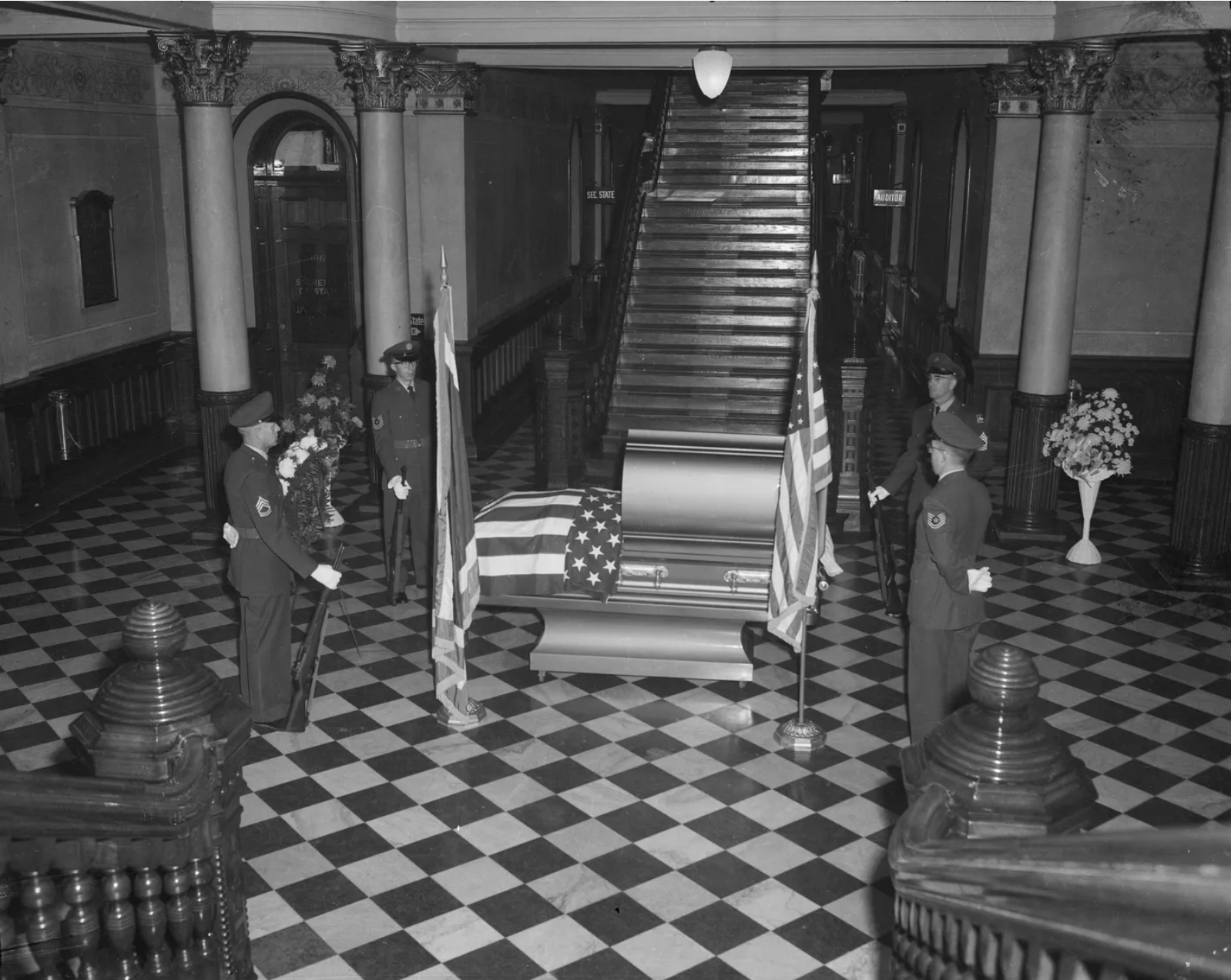
U.S. Sen. Lester Hunt's coffin lying in state in the rotunda of the Wyoming State Capitol. (Brammar Collection/ Wyoming State Archives)
The Capitol Police officer didn’t think much when U.S. Sen. Lester C. Hunt greeted him on the way to his office carrying a .22 caliber rifle. It was June 19, 1954. Security was looser then, before the towers fell, before the Jan. 6 riots. Before we began thinking the unthinkable.
Though he seemed in good spirits, the popular Democratic senator from Wyoming was thrashed. Public service can have that effect on the well-intended. Hunt was nearing the end of his first term amid the din of McCarthyism, a period pockmarked by suspicion, accusation and the demonization of political opponents. Hunt viewed Sen. Joe McCarthy as a liar and a drunk. He was appalled at the ease with which McCarthy bullied colleagues, exaggerated evidence, and played fast and loose with the truth.
I’ve been thinking a lot about Hunt lately, troubled as he was by the cruelty with which McCarthy and his cronies treated their political opponents. McCarthyism’s tactics were not dissimilar to those of faceless political action committees which have infiltrated our state, a cowardly love child of the Wyoming Freedom Caucus who gin up the electorate with disinformation or blatant lies, its message a thrumbeat of fear and tribalism.
This is not the way we do things in the West, Hunt must have thought. He arrived in the Senate in 1948 after a successful career as a state legislator, secretary of state, and two-term governor. He was a hard worker. He was quiet by nature, outspoken by necessity. This is the love language of those of us truly from the rural West.
There was something else troubling Hunt, more personal and deeply upsetting. A year earlier, his 25-year-old son, Lester “Buddy” Hunt was arrested in Washington D.C. on a “morals charge” for propositioning a male undercover police officer. Sen. Hunt and his wife Nathelle had sat through a blistering trial as the prosecutor described their child in the language of the day: a sexual deviant lacking in moral fiber. The judge concluded the trial stating the charge was “one of the most degrading that . . . [could] be made against a man.”
Word of Buddy’s crime would not land well back home. Wyoming, so steeped in the ethos of “Real Men,” home to the original Marlboro Man, the very face of rugged masculinity, where men are tougher than the hides they ride. We are still that way. To make matters worse, it was an election year, and the Democrats had a one vote majority in the Senate. Hunt, who had never lost an election, was a sure bet to win.
Buddy’s troubles were a gift to the Republicans. Sen. Hunt was ripe for exploitation and Republicans, eyeing a chance to control the Senate, pounced. Before Buddy’s trial date Republican Sens. Herman Welker of Idaho and Styles Bridges of New Hampshire, allies of McCarthy, got a message with an ultimatum to Hunt: withdraw from the Senate race and Buddy’s charge would be dropped. Seek reelection and Buddy would be prosecuted. All of Wyoming would know. They would make sure of that.
Let’s simmer for a moment here, gauge the glee Welker and Bridges must have felt. Imagine. A senator’s son caught red-handed in a career-killing homosexual act. It was not a good time to be gay. In 1948, Congress passed an act enabling the arrest and punishment of people who acted on same-sex desire, labeling homosexuals as “sexual psychopaths” likely to attack at any moment. Pull your children closer to your side.
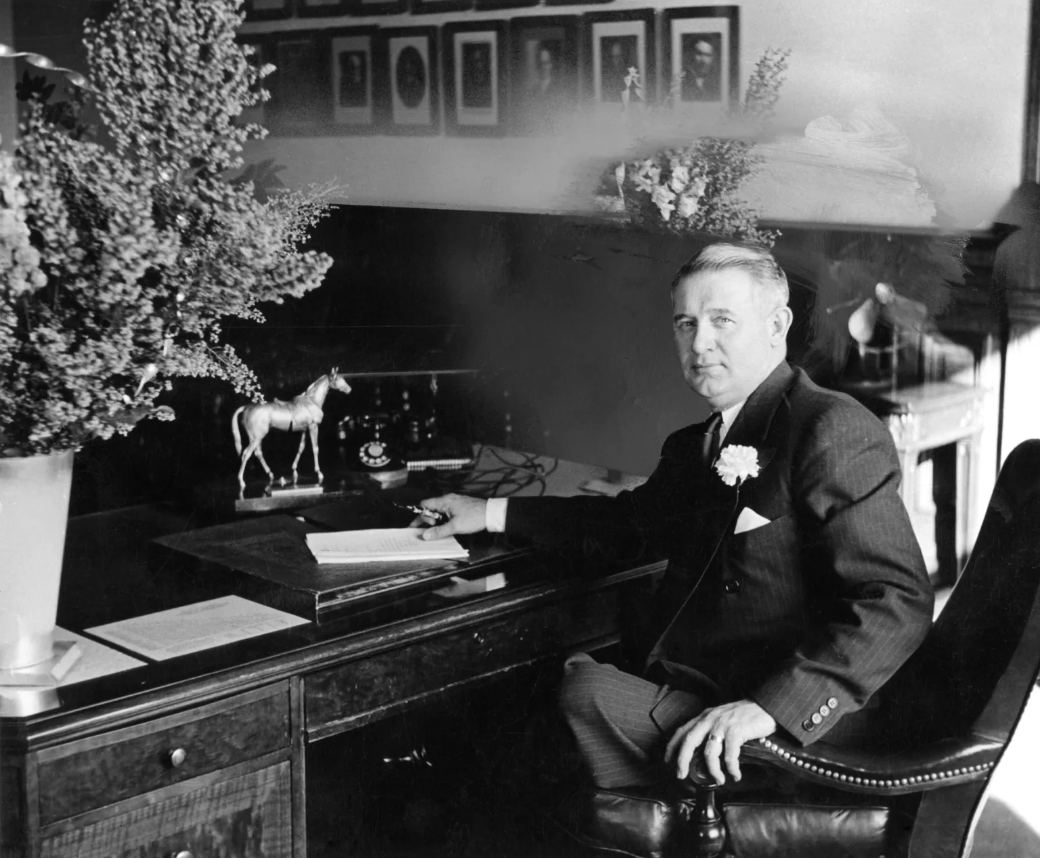
A photo of Lester Hunt at the time he was governor of Wyoming seated at his desk. (Wyoming State Archives)
Outwardly defiant, Hunt refused to be blackmailed and pressed forward with his campaign and Buddy was prosecuted. Privately, he waffled. What followed was a year of torment. Welker and Bridges pummeled him with continuing threats, demanding he withdraw. The Democrats pressured him to stay in the game. He was wracked by guilt. He felt he had tossed his family into the arena, chum for the sharks. His apartment was ransacked, apparently by someone looking for something incriminating to use against the senator. He grasped for lifelines, confiding to a friend, “[F]act of the matter is I would appreciate some discouragement if I could get enough to justify my getting out of the game.” This is a portrait of a tortured man. Several weeks after announcing his reelection campaign Hunt reversed his decision and announced his retirement.
It was everything all at once at the same time, a confluence of sorry events that found Hunt in his office that Saturday in June, 1954, gun in hand. A day earlier McCarthy announced he was planning a hearing to investigate an unnamed senator who had allegedly taken a bribe. The message was clear to Hunt: we’re coming after you next, pal. After 6 years of Perpetua Horribilis, Hunt felt trapped, unable to continue in the Senate’s circus but impossible to retreat. He died of a self-inflicted gunshot wound.
There is a throughline here: The capacity of humans to do horrible things to one another for personal gain and a corresponding inability of the principled to respond. Hunt was unprepared for big league treachery and the repugnant bite of McCarthyism, the nonsense witch hunts which had nothing to do with the bland business of running a country.